

You've decided to buy a standing desk. Then you hit the product listings and find yourself staring at "single motor," "dual motor," "triple motor" and wondering whether you're about to over-engineer your home office.
Here's the short answer: most home office users need a dual motor desk. Single motor is a smart budget pick for light setups. Triple motor is for L-shaped desks and are for heavy setups.
The rest of this guide explains exactly why, with real specs and real products so you can make the call confidently.
What the Motor Count Actually Changes
The motor is the engine of a height-adjustable desk. It drives the telescoping legs up and down every time you switch between sitting and standing. The number of motors affects four things:
Speed. More motors mean faster transitions. A single motor desk typically moves at 25–35 mm per second. Dual motor desks often reach 38–45 mm per second. If you switch positions ten times a day, that extra few seconds adds up.
Lifting capacity. The published weight limit is the most practical number to focus on. Single motor desks typically handle 70–80 kg. Dual motors push that to 100–125 kg. Triple motor desks — particularly on L-shaped frames with three or more legs — distribute load across the entire surface and can comfortably handle 150 kg or more.
Stability at height. This is where budget single motors can let you down. At full extension (typically 120–125 cm), a desk with a weaker motor and thinner steel will wobble noticeably if you have two monitors and a desktop PC on top. A good dual motor frame with solid steel columns stays firm.
Noise. A premium motor at any tier runs at around 40–45 dB — a fridge hum. Budget motors, particularly cheap single-motor units, often hit 50–55 dB, which is audible through the walls in a UK terrace or semi-detached. Worth knowing if you're in back-to-back calls.
Single Motor: The Honest Case For It
A single motor drives both legs via a mechanical linkage, a cross-bar or synchronised shaft that keeps both sides moving together. When it's well-engineered, the result is smooth, quiet, and reliable. When it's not, you get wobble and drift.
The key question is what you're putting on the desk. If your setup is a laptop, maybe a single external monitor, a keyboard and mouse, and some notebooks - you are not going to stress a single motor desk. You're probably well under 40 kg of load, and the desk will serve you perfectly for years.

The other honest case is budget. A good single motor desk from a reputable brand is a meaningful upgrade over a static desk, and it costs less. If the choice is between a quality single motor desk and a cheap dual motor from a brand you've never heard of, take the quality single motor every time.
What Ergonest carries in the Single Motor collection: three desks, all Yo-Yo branded, from £232.99 up to £399.95. The entry point is the RISE Edition: a stripped-back frame that does exactly what it says. The Yo-Yo DESK HOME steps up with a nicer desktop finish and slightly better stability, and sits in the sweet spot for students or remote workers with a compact setup. The PRO 1 sits between them.
Choose single motor if: your desk load is under 50 kg, you have one monitor or a laptop, and budget matters.
Dual Motor: Where Most Buyers Should Land
With a motor in each leg operating independently — coordinated by a control board — dual motor desks are more powerful, more stable, and better suited to the way most home offices actually look in 2026: two monitors, a laptop dock, perhaps a desktop tower under the desk driving extra weight through an arm.
The speed and capacity jump is real. The Dual Motor collection at Ergonest runs from the Exec 2 (an entry-level dual motor that undercuts most of the single motor market on price) up to the FRISKA Aspa Endurance (a designer piece built for commercial interiors). The sweet spot for a home office is in the £550–£800 band.
Two desks stand out there:
The Yo-Yo DESK PRO 2 is the most accessible dual motor desk in the range — a no-nonsense frame with programmable height presets, anti-collision sensor, and a 125 kg lifting capacity. It handles a dual monitor setup without protest and is quiet enough for open-plan rooms. If you want one upgrade over the PRO 2, the Yo-Yo DESK PRO 2+ adds extra height range and a refined control panel.
Further up the range, the WELLNESS 2 Smart and WELLNESS 2+ add app connectivity and a wellness-tracking feature that nudges you to stand — useful if you're trying to build the habit rather than just having the hardware.

For a premium designer finish, the FRISKA Stockholm Heavy-Duty is built for 150 kg+ loads with a Bluetooth controller and a Scandinavian aesthetic that holds its own against anything on the market.
Choose dual motor if: you have two or more monitors, you switch positions frequently throughout the day, or you want the desk to still feel solid in five years.
Triple Motor: For L-Shapes and Heavy Builds
Triple motor desks solve a specific structural problem. An L-shaped desk or any desk with three or four legs has a corner joint that experiences different forces than a standard two-leg frame. Put two motors on an L-shaped desk and the corner leg either has no motor at all (which creates flex) or is mechanically linked to one of the others (which reduces stability). Add a third motor and every leg moves with independent power, perfectly synchronised.
The practical result: an L-shaped triple motor desk handles heavy corner loads without twist or wobble, even at full extension. It's the reason every serious corner desk should have at least three motors.
Ergonest's Triple Motor collection has four desks. The FRISKA Stockholm Height Adjustable Corner Desk is the flagship — an L-shaped configuration with Bluetooth control, deep desktop surface, and the kind of build quality that suits a proper home studio or executive home office. The EXEC 3+ L-Shaped is the entry into triple motor corner territory.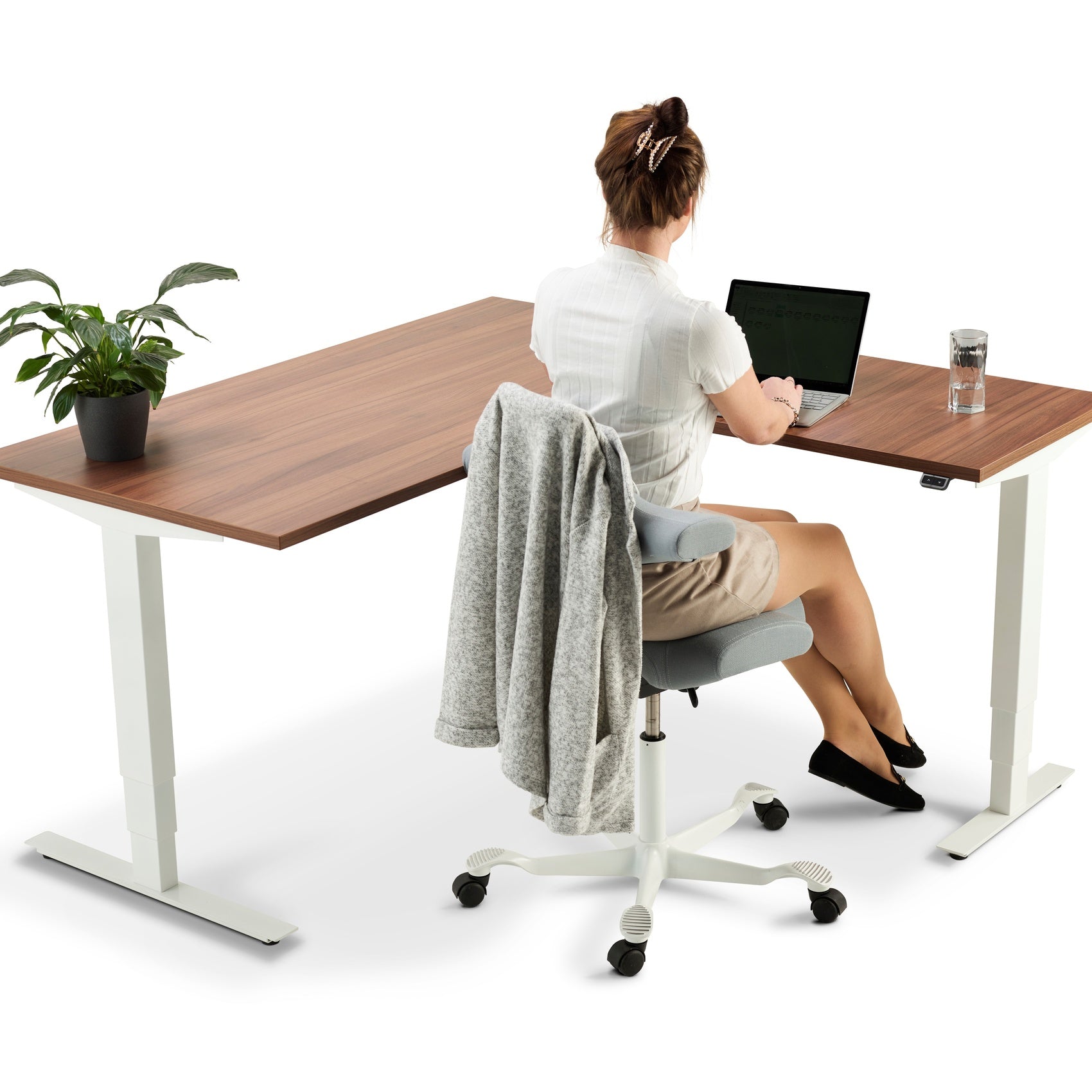
The two outliers are the Yo-Yo DESK PRO 3 and PRO 3+ - straight desks (not corner) with triple motors. These exist for users who want maximum stability and a high weight limit on a standard rectangular surface, typically a full tower workstation, triple monitor arm, or broadcast rig. If your load approaches 150 kg and you're not buying an L-shape, the PRO 3 is your desk.
Choose triple motor if: you're buying an L-shaped or corner desk, your load exceeds 130 kg, or you need maximum stability for a professional-grade rig.
The Quick-Decision Table
| Single Motor | Dual Motor | Triple Motor | |
|---|---|---|---|
| Typical load limit | 70–80 kg | 100–125 kg | 150 kg+ |
| Best for | Laptop + 1 monitor | Dual monitors, desktop | L-shapes, heavy rigs |
| Ergonest price range | £232–£400 | £359–£2,937 | £800–£1,589 |
| Speed | Standard | Fast | Fast |
| Stability at height | Good (light loads) | Very good | Excellent |
Which Ergonest Desk to Buy
If you're still weighing it up, here's where to start:
Budget home office (laptop + one screen): Yo-Yo DESK HOME — £399.95
Most home offices (dual monitors, daily use): Yo-Yo DESK PRO 2 — £549.95 or PRO 2+ at £649.95
Heavy setup, single desk (desktop PC, triple monitor arm): Yo-Yo DESK PRO 3 — £799.95
L-shaped or corner workspace: EXEC 3+ L-Shaped — £1,126.98 or FRISKA Stockholm Corner — £1,589.00
Browse all motor tiers on the Ergonest Standing Desks page, or go straight to the Dual Motor collection if you already know that's where you're landing. Free UK delivery on orders over £500, with full warranty and UK-based support on every desk we sell.
Prices correct at time of publication. Check individual product pages for current pricing and availability.